
Behind the Music
Rudra has been called pioneers of “Vedic Metal.” Looking back, what do you think has been the biggest challenge in balancing traditional philosophy with extreme metal?
The biggest challenge has always been perception on both sides. From the metal scene, we’ve had people who couldn’t understand why we were bringing in Sanskrit verses and ancient philosophy. And from the traditional side, we’ve had people who couldn’t accept the perceived sacred ideas expressed through distortion and growls. But to us, there’s no contradiction. Both traditions deal with radical transformation – whether it’s philosophical inquiry or sonic catharsis. The real task was staying true to both worlds without diluting either. And I think we’ve managed that because we never treated Vedic philosophy as a gimmick or metal as just sound. We lived both.
Many of your songs draw from ancient texts. How do you decide which concepts translate best into music?
We don’t look for what’s ‘marketable’ or ‘catchy.’ We look for what speaks to our collective inner fire. Some concepts like the transience of the ego, the delusion of duality, easily lend themselves to the aggression and intensity of metal naturally. Other times, we might spend weeks sitting with a text, combing through the verses, until something stirs musically. When the idea and the riff align, then we know it belongs in a song. It’s an aggressive but meditative process.
Singapore isn’t known globally for death metal. What unique advantages or struggles have you faced building a fanbase here?
We came up when there were hardly any platforms for metal in Singapore. Gigs were underground literally and culturally. So yes, the struggle was real. But the flip side was that we weren’t boxed in by anyone’s expectations. We could be as experimental, as philosophical, as brutal as we wanted to be. And we kept putting out music without long breaks between albums. As a result our fanbase (we prefer friend-base) grew slowly but deeply, people who resonated with what we were doing musically stuck around. And being from Singapore, with its mix of cultures, gave us a kind of flexibility. We didn’t have to play by anyone’s rules, because there were no rules. That was a gift.
Live shows are central to metal culture. What has been your most memorable performance — both locally and overseas?
It has to be our US and Canada tours. Locally our groundbreaking and memorable show was the one we staged in 2021 with three other indian classical musicians. These have been our high points of our career.
After decades together, what still excites Rudra the most when stepping into the rehearsal room or studio?
Honestly, the unknown. Every time we step into the room to write songs, there’s this sense that we’re about to summon something interesting, something that doesn’t yet have form. That moment when a groove locks in, or a verse suddenly feels like it’s meant to be screamed, that’s what we look for in the studio. We love that feeling when everything falls into place. That’s what keeps us going.
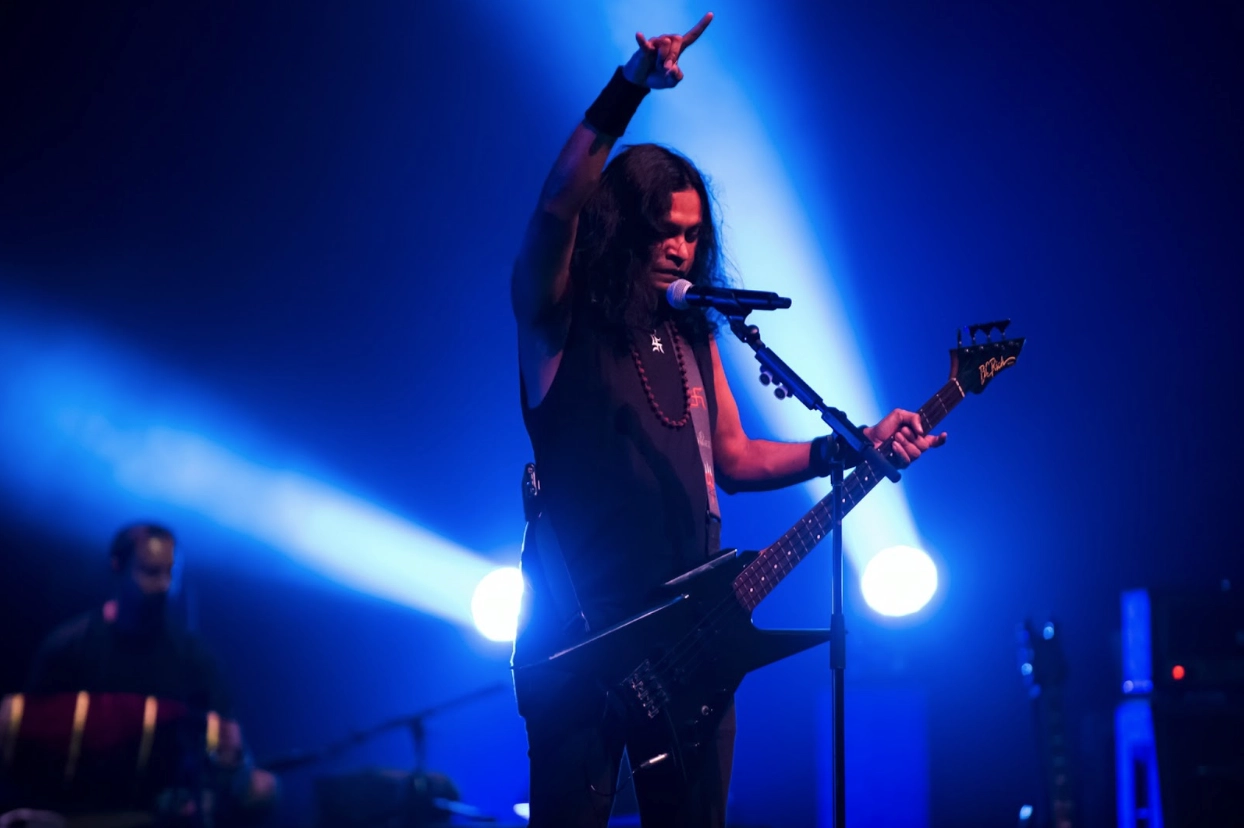
Kathirasan K
Vocals, Bass
Songwriting/Music Craft
How has your vocal approach evolved since Rudra’s early years?
During Rudra’s formative years leading up to our debut album, my vocal style was predominantly guttural. However, starting with The Aryan Crusade, I refined my approach by incorporating higher vocal ranges. This adjustment made my lyrics more discernible to listeners, enhancing the overall impact. Since then, this refined vocal style has remained a consistent hallmark throughout my career.
Bass in extreme metal often gets buried. How do you balance technical bass work with Rudra’s dense sound?
My bass playing style is rooted in simplicity, focusing on delivering a solid, cohesive low end that bridges the gap between the guitars and drums. Rather than employing technical flourishes, I prioritise groove and foundational support, creating a steady backbone for the music. I seldom use the first and second strings unless there’s a specific need to highlight a lick or add a distinct accent.
For live performances, achieving clarity amidst the dense mix of guitars and drums requires careful equalisation. This ensures my bass tone cuts through the sonic wall effectively, maintaining its presence without overpowering other instruments. In the recording studio, mixing is key to balancing warmth and clarity, allowing the bass to shine while complementing the overall sound.
When writing lyrics inspired by Vedic texts, what’s your process for staying authentic yet accessible?
Most Vedic texts are written in Sanskrit, a language with which I have working knowledge. This proficiency enables me to study these texts thoroughly, seeking themes that align with the focus of each album. Typically, my lyrical inspiration revolves around non-dual consciousness, reflecting the philosophy of Advaita. While social commentary could be an exception, I have consciously avoided it since 2005, choosing instead to stay authentic to traditional textual themes.
I acknowledge that my lyrics may not be easily accessible due to their abstract nature. A foundational understanding of Advaita or non-dual consciousness often enhances appreciation. However, the fact that 95% of our lyrics are in English helps maintain legibility for a global audience.
Live Performances
As the frontman, how do you keep energy high across long, demanding sets?
Actually, maintaining high energy on stage comes quite naturally to me. I draw immense motivation from the audience’s enthusiasm and the dynamic sonic atmosphere that unfolds during performances. This vibrant interaction fuels my presence, keeping me engaged and spirited throughout the set. Of course, a can of Monster energy drink also helps to keep the momentum going!
Any pre-show rituals rooted in philosophy or spirituality?
I don’t follow any specific pre-show rituals rooted in philosophy or spirituality. My preparation is simple: I glance at the setlist, step onstage, and let the moment guide me. Typically, only about 30% of what I say is scripted; the rest flows organically, shaped by the energy of the crowd and the atmosphere of the performance. As already mentioned, a can of monster energy drink has been part of the ritual for about 10 years now.
Philosophy & Perspectives
What’s one misunderstood aspect of Rudra’s philosophy that you’d like fans to know?
There is a significant distinction between Vedic and Hindu. While Hinduism has Vedic roots, not all Vedic concepts are explicitly present and expressed in medieval or contemporary Hinduism. I believe that the majority of Hindus may not fully grasp the lyrical themes I explore in Rudra. My focus is on presenting early Vedic (pre-Hindu) philosophy, dating back as far as 1500 BCE, as a form of philosophical art through our music. Also my focus is on Advaita (non-dualism).
Hence, I feel uneasy when Rudra is labeled as a Hindu metal band. We identify as a Vedic metal band. This is not due to any issue with the term “Hindu,” but because it does not accurately reflect our artistic and philosophical foundation as a metal band.
Has age/experience shifted your interpretation of Vedic texts compared to your early days?
Certainly, in my early days, I drew upon Vedic philosophy to fuel my social commentaries. However, as I matured, I found that this approach no longer resonated authentically with me. I’ve since shifted my focus towards allowing the textual themes themselves to guide my lyrical content, minimising my own superimpositions.
With age, I’ve also explored non-dual concepts beyond Vedic traditions, delving into philosophies such as Stoicism, early Taoism, Sufism, early Buddhism, and Christian mysticism, including Gnosticism. These explorations have enriched my understanding and continue to shape my lyrical approach.
Death metal is often linked with aggression — how do you reconcile that with spiritual messages?
In my perspective, spiritual messages can be remarkably intense and confrontational because they demand unwavering honesty and internal self-examination. Unlike religious doctrines that often emphasise communal harmony and collective rituals, spirituality delves deep into personal growth, challenging individuals to face their truths without compromise. This intrinsic intensity makes metal the perfect medium to express such profound and relentless themes.
Consider this stanza from our song Justified Aggression, which encapsulates this sentiment:
“I am the battlefield. I am the slayer and the slain.
And yet I am not any of it. This war is real yet unreal!”
Which Rudra song best represents your personal journey?
That’s a difficult question. I would say ‘Ananda’.
What advice would you give younger Asian metal bands trying to merge heritage with modern music?
Embrace it wholeheartedly. Your heritage is the essence of your uniqueness, infusing your music with an identity that sets you apart. Even if you don’t achieve widespread success, you will have succeeded in staying true to your authentic self.
Gear/Technical
What’s your go-to bass guitar and why?
For the past 30 years, my go-to bass was the BC Rich Ironbird Custom. Its sound has always been phenomenal, delivering rich, powerful tones that perfectly complemented Rudra’s intense sonic landscape. However, in recent years, the electronics developed persistent issues, particularly with RF noise that has proven difficult to resolve.
Consequently, I transitioned to a new custom bass that I personally designed and had crafted by Earbleed Guitars. This bass is notably lighter and more compact, a feature I deeply appreciate as it allows greater mobility on stage, especially as I grow older. The ergonomic design not only enhances stage presence but also ensures that I can perform energetically without the physical strain of heavier instruments.
Do you prefer active or passive pickups for Rudra’s sound?
I find active electronics challenging due to their complex controls and the extensive calibration required for my effects processor. In contrast, I’m drawn to passive electronics for their natural, warm sound, which feels more organic and authentic. This tonal quality offers me greater control, allowing me to accentuate nuances more effectively through my effects processor.
How do you set up your bass EQ in the mix so it cuts through?
I just focus on the tone. I love the bottom heavy 80’s bass tone. I use a custom patch on my Zoom B2 Four that has a filter, light distortion, and a SWR SM-400S amp simulator.
Which vocal mic do you swear by for both studio and stage?
I usually leave this to the engineers. I have no preference.
Do you use any vocal effects live or keep it raw?
I don’t use any. The engineers add the usual effects on their sound board.
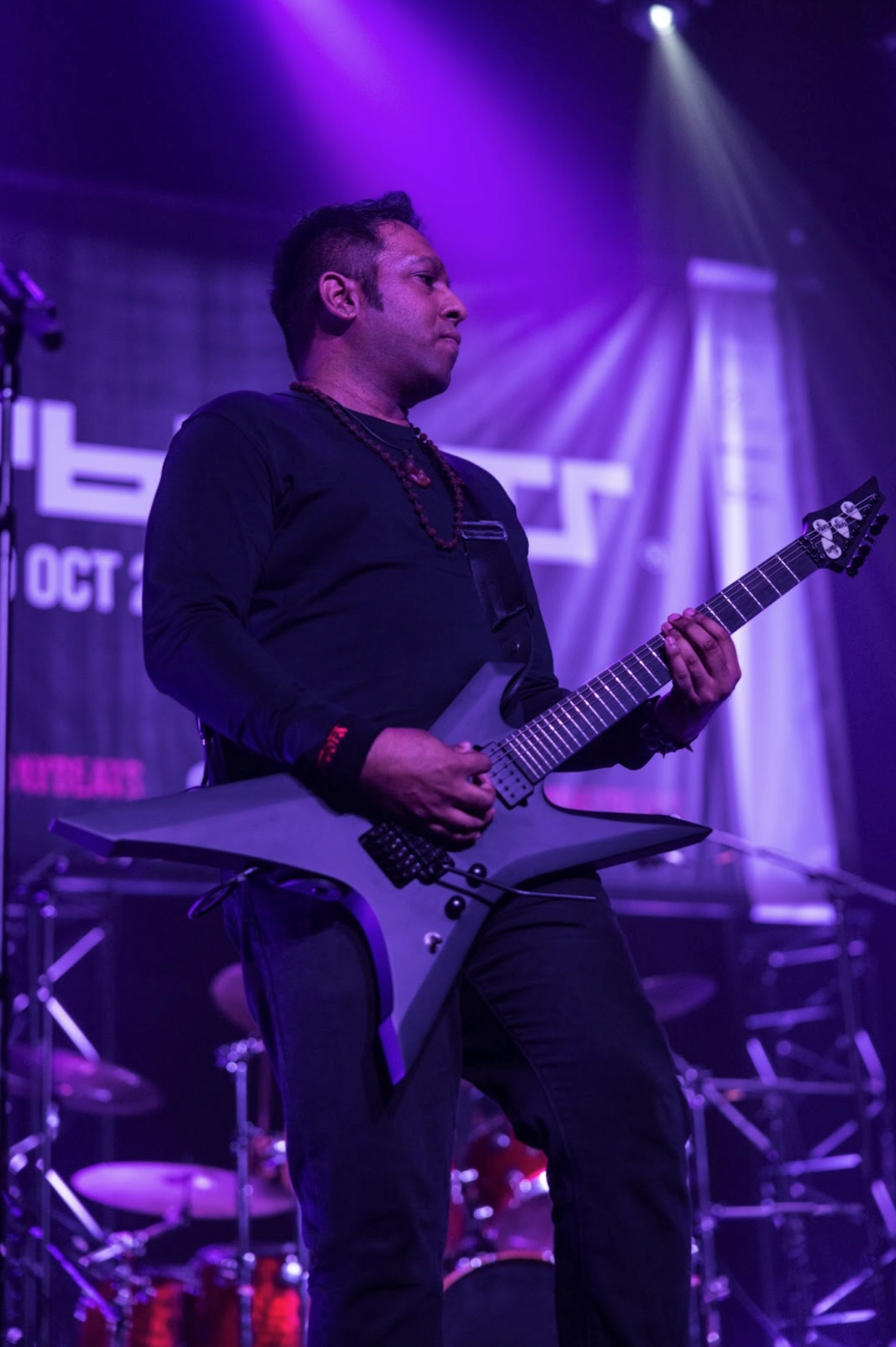
Vinod Vaskaran
Guitars
Songwriting/Music Craft
How do you approach riff-writing while balancing melody with brutality?
For me, riffs have to carry both weight and feel. I usually start with rhythm as the backbone. Then weave in melodic phrases of some of my personal used Indian scales. That balance of heaviness and melody is what gives Rudra its character. Sometimes the melody is subtle, almost hidden within the brutality, but it’s always there.
Are there specific scales or ragas you lean on to bring out the “Eastern” sound?
I usually study tunes from music I hear or Carnatic vocals and I try to mimic it. I’ve never personally studied ragas to know exactly what ragas I’m using.
What guitar gear or effects have become essential to achieving Rudra’s sound?
A tight death metal sounding distortion and a lush delay are essential. Over a decade, ENGL Preamp combined with TC Electronic G Major 2 had been my main rig for recordings, jamming and for some live setup. Just recently, less than a year ago I’ve moved on to mainly Fractal FM9 and sometimes Kemper player for amp modeling, effects, and precision live.
Live Performances
Which song is most fun for you to play live — and which is technically the hardest?
The Pathless Path to the Knowable Unknown. I enjoy this mainly for the crowd’s involvement. They know the lyrics and they dance to the music. Really fun to watch.
For ‘Technically hardest’, no songs in particular. But having to relearn some of my complex solos that i wrote during the album recording sessions. It’s sometimes challenging to remember how I exactly played them.
What’s the biggest challenge in translating Rudra’s complex studio work to stage?
Layering. In the studio we can build multiple guitar tracks and melodies/3rd guitars but live we’re limited. So I have to be very deliberate in how I use effects and how I fill space. Sometimes it means simplifying certain parts, but the challenge is to keep the essence intact.
Philosophy & Perspectives
How has being in Rudra shaped your personal identity as a guitarist?
It’s made me realize that being a guitarist isn’t just about shredding or tone. It’s about serving the music’s purpose. Down to even when I write my leads. It needs to express a story and feel. Rudra pushed me to think about philosophy and storytelling through guitar. That’s become part of my style. I don’t just play riffs, I try to channel meaning.
Do you see Rudra’s music as more about storytelling, or more about atmosphere?
It’s both. The lyrics and themes tell a story, but the atmosphere created by the music allows listeners to experience it beyond words. I’d say the story guides the structure, while the atmosphere makes it transcendental.
Metal guitar often glorifies speed — but Rudra emphasizes mood. How do you balance the two?
To me, mood and feel is primary. That’s the most important. Speed is secondary. Ultimately, no matter how fast or slow the guitars are played, the drums plays a bigger role in the dynamics on how that section of the song will sound.
Who outside of metal has influenced your playing the most?
Outside of metal, I follow many virtuosos such as Steve Vai, Marty Friedman, Malmsteen, etc. I also follow electronic artists such as, Perturbator, Juno Reactor, etc
What message do you want fans to take from your guitar work in Rudra?
I hope my playing gives fans an emotional journey. Whether it’s energy, anger, calm, or reflection. If people can connect with their own inner world through the riffs, then that’s the message I want them to take.
Gear/Technical
What’s your current live rig — guitar, amp, pedals — and how has it evolved?
Right now, I mainly use Fractal FM9 as the core of my rig. Before that, it was the G-Major 2 with ENGL tube preamp. Guitars-wise, Jacksons, Ibanez and BC Rich have been my go-tos for their playability and tone. The rig has evolved from bulky racks and pedals to streamlined digital setups that can still deliver Rudra’s layered sound.
Do you rely more on amp distortion or pedals for Rudra’s tone?
Amp distortion is the main foundation. Effects like Reverb, Delay, pitch shifter, chorus, etc are there to color it or give a different feel. With the new FM9, I’m inspired to try out more effects in our future song writings.
Any custom tunings or string gauges you use for Rudra’s riffs?
We’re on standard D tuning. Regular 10-46 gauge for the strings.
How do you handle feedback/noise control when layering effects?
I’m conscious about gain-staging. If you over push every effect, you invite noise hence I am usually cautious on how much gain and delay I stack.
If you had to strip your setup to just one guitar and one pedal, what would they be?
It’ll be my Ibanez xiphos and Fractal FM9.
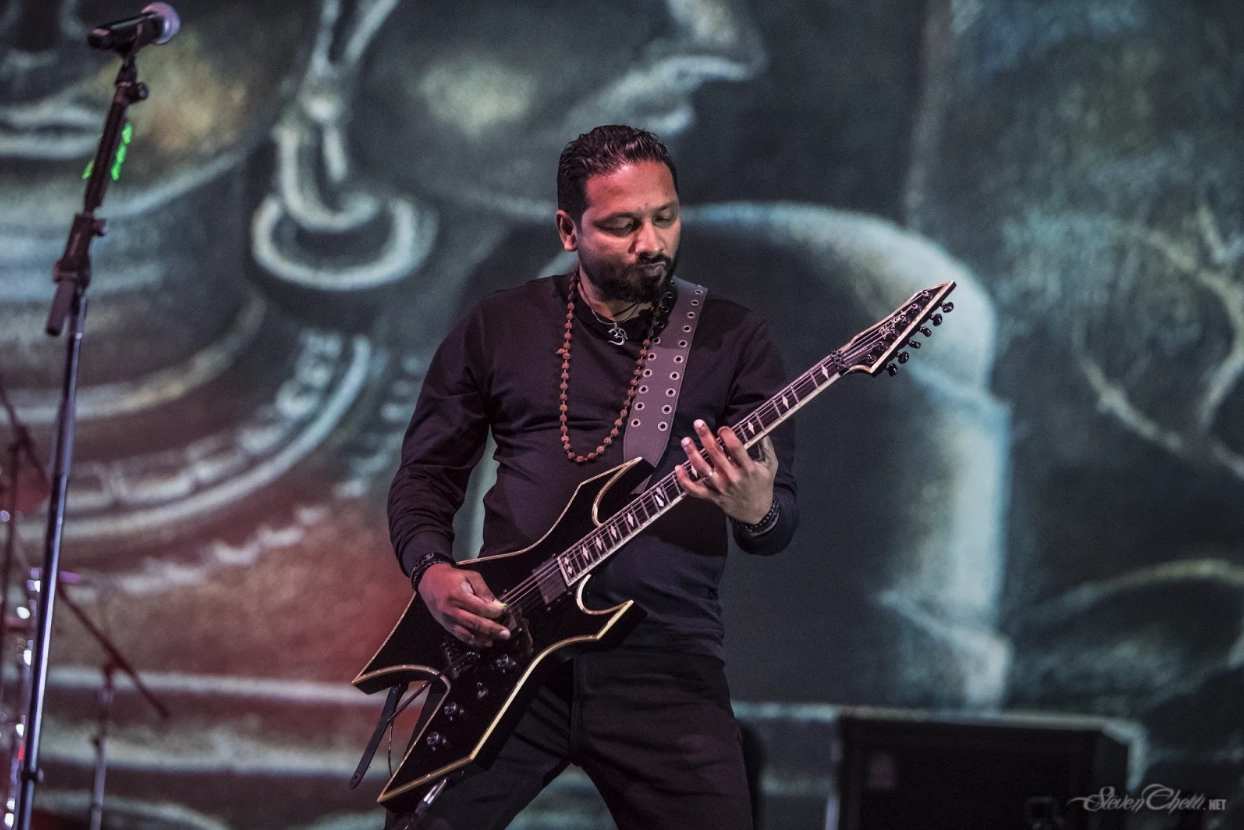
Devan Andoor
Guitars
Songwriting/Music Craft
Joining Rudra later, how did you find your place in an established sound?
I was part of Rudra from 2007 to about 2011 and then I took a break for about a decade before rejoining Rudra in 2021. I have always been playing melodic death metal and have been incorporating indian scales to my guitar playing so it felt second nature to be honest. Being part of Rudra seemed seamless.
How do you and Vinod divide or complement each other’s guitar roles?
We do not really divide our guitar roles. When we jamm together as a band we already have a feel of where we would complement each other with a harmony or a counter melody. When we write songs outside of the studio we try and do a riff exchange. For instance Vinod will record 3 to 4 riffs and send it to me and I would then add new riffs of my own or play a complimentary over his riff. This happens back and forth before we bring the riffs to the studio to work as a band. The only area we probably will divide is where each of us would play lead guitars.
Which Rudra song do you feel showcases your personal guitar style best?
Hymns from the Blazing Chariot from the Bramavidya: Transcendental I album.
Live Performances
What’s the most intense crowd reaction you’ve experienced with Rudra?
To be honest I cannot really remember but I would say the 2011 Baybeats show stood out to me. I saw quite a huge crowd and there were many of them who were body surfing and moshing!
How do you keep chemistry onstage when the music is so demanding technically?
We love playing the songs so when we are on stage we are already enjoying ourselves. I believe that’s what keeps our chemistry on point when we are on stage.
Philosophy & Perspectives
What drew you personally to Rudra’s fusion of metal and Vedic themes?
The pounding drums and death metal guitar riffs with indian scales and the vedic chants all resonate deeply with me.
How do you see Rudra’s message resonating with younger fans today?
The younger generation feels the same intensity we did when we started. Our music gives them energy but our message gives them perspective. I believe that combination is why Rudra still resonates with them today.
Do you think Rudra’s music can inspire more Asian bands to embrace heritage in extreme metal?
Yes for sure. We are proud of our heritage and we show that it is possible to embrace it in extreme metal.
What’s your proudest moment since joining Rudra?
There is not one moment I can pinpoint. Every moment being part of Rudra makes me feel proud.
If you had to summarize Rudra’s legacy in one sentence, what would it be?
Rudra’s legacy stands as testament to tireless dedication, unbreakable unity and an unyielding spirit that continually pushes through boundaries of music while persevering through every hardship.
Gear/Technical
What guitar and pickups do you prefer to achieve Rudra’s balance of clarity and heaviness?
I usually prefer using B.C. Rich Warlock and Ironbird as my main guitars for recording and live. In terms of pickups I use the EMG 81 and Dimarzio Super Distortion predominately for most of my guitars.
Which pedals or processors are indispensable in your live chain?
Right now I am using either the Kemper Stage or Kemper Player with my Shure GLDX16+ wireless system for most live shows.
How do you sync your tone with Vinod’s while keeping individuality?
We usually have very similar tones. My tones are predominantly slightly treble heavy compared to Vinod’s.Usually before any live shows we will review the bands overall sound and tweak if necessary at our studio or during soundcheck at the venue.
Do you use modeling gear (e.g. Kemper, Helix) or stick to traditional amps?
I love traditional amps but they are just not practical for us to use in this day and age. Right now I stick to modelling gears. I currently have the Kemper stage and player and Fractal FM9 and am trying to use them for studio and live exclusively.
What’s your string gauge/tuning choice for Rudra’s material?
For Rudra the tuning we currently use is D Standard (1Full step down). As for strings I have been using D’Addario strings for the last 20 over years. To be specific I have been using D’Addario’s EXL110 Nickel wound, Regular Light 10-46 strings for most parts but have recently started using D’Addario NYXL1046 Nickel wound strings.
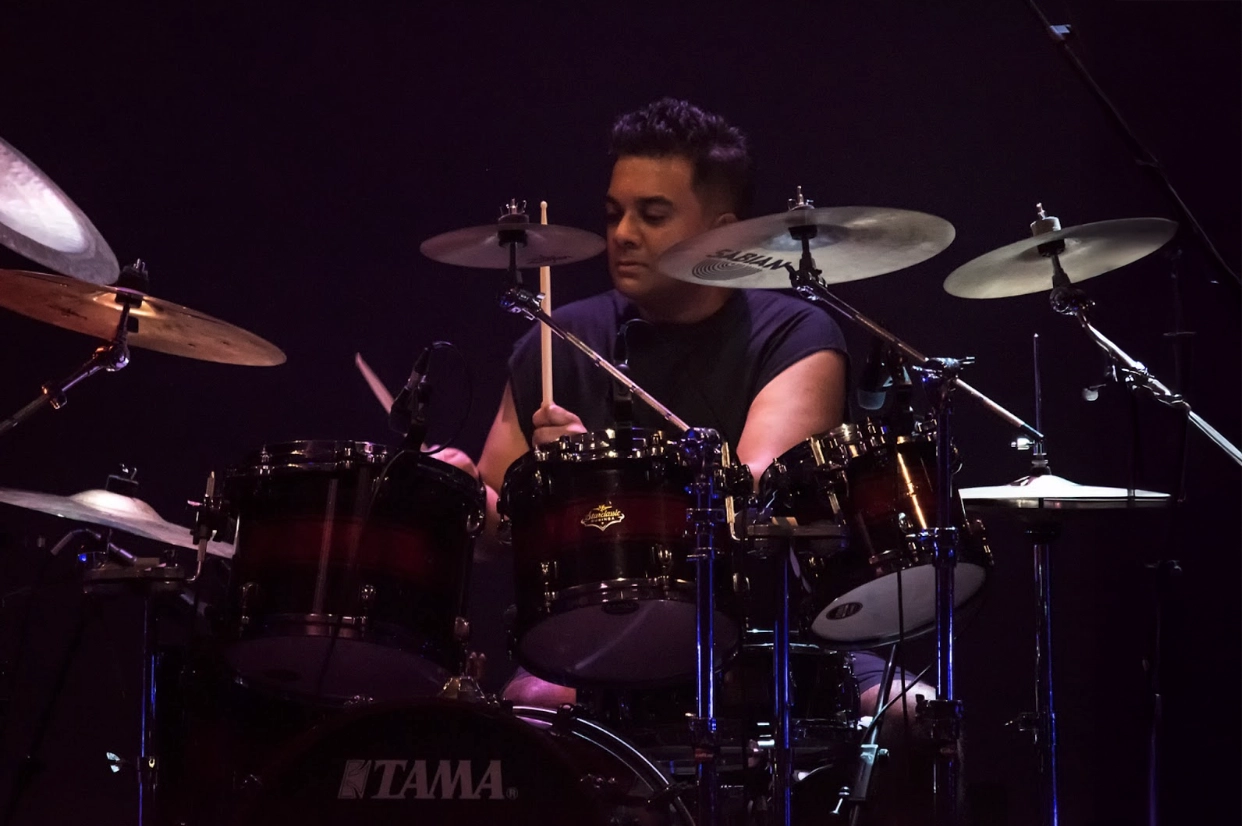
Shiva
Drums
Songwriting/Music Craft
Extreme drumming is physically punishing. How do you maintain stamina and technique over the years?
It’s all about practice, practice, practice. We don’t play many shows, but when we do, it’s full intensity—no shortcuts. I treat each performance like a physical and mental peak, so the prep is brutal: long workouts, focused drills, and gear tuned for control and comfort.
Do you compose drum parts to serve the riffs, or do you sometimes lead the rhythm direction?
It’s a mix of both, really. Most of the time, I compose drum parts to support the riffs and vocals—that’s where the core energy lies. But there are moments where the drums take the lead, especially when shaping transitions, building tension, or driving rhythmic shifts. It’s about knowing when to anchor and when to push the momentum forward.
Any Indian rhythmic traditions that influence your playing style?
I don’t follow any formal Indian rhythmic traditions like Carnatic or Hindustani tala systems, but I’m deeply shaped by the folk songs and devotional music I’ve grown up with. It’s not about replicating traditional structures—it’s about absorbing the phrasing, the emotional weight, and the pulse. Bhajans, Tamil temple rhythms, and tribal drumming from regions like Odisha and Maharashtra all feed into my instinctive sense of groove.
Live Performances
What’s been your toughest live gig physically, and how did you push through?
Every show is physically demanding, no exceptions. Whether it’s a metal gig or something more orchestral, whether the crowd’s massive or intimate—I push myself to the absolute limit. I treat each performance like it’s the last one I’ll ever play. The prep is intense, and once I’m on stage, it’s full commitment. There’s no such thing as holding back.
How do you keep energy tight between you and the rest of the band during shows?
It’s all about listening and locking in. We stay connected through eye contact, body language, and knowing each other’s cues. Once the groove is set, the energy flows naturally. It’s magical… hahaha.
Philosophy & Perspectives
What mental state do you aim to achieve before performing?
Before performing, I aim for calm intensity – focused, grounded, and fully present. I treat it like a ritual: tuning into the emotional weight of the music, and mentally rehearsing the flow. Whether it’s blast beats or traditional transitions, I need to feel in control and connected.
How has drumming for Rudra shaped your personal discipline outside of music?
Drumming for Rudra has shaped my discipline far beyond the stage. The intensity and precision required—especially in extreme and Vedic metal—demand a mindset of total focus, consistency, and respect for structure. That carries into everything I do: policy drafting, communication, even how I manage time and physical space. It’s not just about playing tight—it’s about living with intention and clarity.
Many see drumming as primal — how do you link that with Rudra’s spiritual philosophy?
Drumming is absolutely primal—but in Rudra, that raw energy is channeled with purpose. The spiritual philosophy behind our music transforms rhythm into ritual. Every blast beat, every groove isn’t just aggression—it’s invocation. I see the drum kit as a sacred space where intensity meets intention. It’s about transcending ego, syncing with something larger, and letting the rhythm speak what words can’t.
Do you think Asian drummers bring something different to extreme metal compared to Western counterparts?
I can’t speak for other drummers directly, but I do hope more Asian drummers start weaving their own traditional beats and rhythmic structures into extreme metal. There’s so much depth in our folk and classical traditions and bringing that into heavier genres could open up powerful new directions.
What’s the one Rudra track where you feel your drumming shines most?
I appreciate the question, but I don’t usually comment on my own drumming. I just try to serve the music and the message as best I can.
Gear/Technical
What’s your drum kit setup (shell sizes, cymbals, pedals) for Rudra?
Shells (Tama preferred):
- Kick: 22”x18” or 20”x18” (depending on venue acoustics)
- Rack Toms: 10”x8”, 12”x9”
- Floor Toms: 14”x14” (tight and punchy for fast fills)
- 16”x16” (deeper resonance for dramatic phrasing and low-end balance)
- Snare: 14”x6.5” (steel or brass for clarity and cut)
Cymbals:
- Hi-Hats: 14” Medium or Fusion
- Crashes: 18” Thin, 19” Medium
- Ride: 20” Dry Ride or Ping Ride
- China: 18” Trashy or Oriental
- Splash: 10” or 8”
- FX: Bell or Stack (for Vedic textures)
Pedals:
- Double Bass: Tama Speed Cobra or Iron Cobra
- Hi-Hat: Adjustable tension, smooth action
Triggers & Electronics:
- Kick and snare triggers
- Sample pad for chants, orchestral hits, or ambient textures
Do you prefer single or double pedals for blast beats, and why?
For faster tempos or when I need that aggressive edge, I go with double pedals for blast beats. But I really enjoy using a single foot when I want more intensity and feel – it forces me to dig in and connect with the groove in a deeper way.
Any go-to drumsticks or heads that define your tone?
I love Vater 5B anytime – solid feel and great balance. Tama hickory 5B is a close second, especially for tighter setups. As for heads, I’m all about Evans:
- Snare: Heavyweight batter // Snare Side 500
- Toms: G2 Clear batter // G1 Clear reso
- Kick: EMAD Heavyweight batter // Custom EQ3 reso
How do you mic your kit in the studio to capture Rudra’s intensity?
To capture Rudra’s intensity in the studio, I close-mic all the drums – kick, snare, toms – for punch and clarity. Overheads pick up the cymbals, and room mics help bring out the natural vibe. I trigger the kick and snare to layer in extra attack and consistency, especially for fast sections. The kick gets two mics – one inside for punch, one outside for low-end. It’s all about making sure every hit comes through clean and powerful.
Do you incorporate triggers or keep everything acoustic for live shows?
I do trigger the kick and snare for live shows. It helps keep the sound consistent and punchy, especially in fast or dense sections. The rest of the kit stays acoustic. I like keeping the natural feel and dynamics intact.